The flows are still too high to get back to work. Here's video from this morning.
If you compare this with the videos from last week, you'll see that as the dam removal got underway, the river was flowing over the bedrock and through the slot in the south spillway. Now it has risen to the point where it is again flowing over the north and south spillways. Hopefully it'll be down enough by tomorrow that SumCo can get back in the water.
You can check out the river's flow in real time, courtesy of USGS, by clicking here
Wednesday, August 17, 2011

A Lesson in Hydrology

This project on the Pawtuxet River has been a good lesson in watershed hydrology. As the work crew was at the site on Monday, preparing water control for removal of the last section of dam, rain was falling steadily and water levels rose as they were working. It became clear by the middle of the day that there would be no more work in the river until water levels fell.
Looking at this hydrograph from the USGS gage in Cranston, you can see the flashy nature of this river system and how it responds to rain events. The first rain event we had on Sunday, August 7th, rose water levels to over 800 cfs. Flows were also being manipulated by a hydro operation upstream. The several inches of rain we had on Monday were enough to increase flow from under 200 cfs to over 1,000 cfs within a few hours. Because the watershed is so large, flows have still not dropped substantially two days later. Some of this is due to the fact that the Scituate reservoir is now full and is spilling over its dam. Flows on Monday were the highest for that day since August 15th 1973 when a flow of 827 cfs was recorded at the Cranston gage.

Rivers respond to what is happening in the watershed. A large amount of impervious surface causes quick rises in river flow. Manipulation from dams and other human influences also cause flow fluctuations putting added stress on the river's ecology and built environment. When flows reach around 500 cfs, we will see the crew back at work on the last section of dam.
Tuesday, August 16, 2011
RI DEM Testing of the Lower Pawtuxet

On the evening of August 10th, Alan Libby from DEM's Fish & Wildlife Division, took his team of four for a trip up river from the Pawtuxet Falls dam to assess the prevalence and variety of fish currently in the river. For the 2 mile section that they examined, they found the following in order of abundance: white sucker, golden shiner, American eel, brown bullhead, pumpkinseed, common carp, yellow bullhead, bluegill, and largemouth bass. By far the most prevalent fish was the white sucker. All fish caught during the sampling appeared healthy according to the team, and are also found in other parts of the Pawtuxet system. No anadromous fish were found, however, including the herring and shad that are target species of this project.
Such testing of the lower Pawtuxet has not been done since the late 90s. With the work completed last week, we now have a baseline for evaluating the primary impact of the dam removal. DEM will continue to conduct annual assessments to measure the degree and rate of restoration of anadromous fish to this river. If resources permit, some stocking of the Lower Pawtuxet will take place to help accelerate the process.
Friday, August 12, 2011
Friday Afternoon--Center Spillway Out
Friday was our fourth day in the water at Pawtuxet Falls. The SumCo crew has completed removal of the center spillway section, and is working back toward the south or Warwick end of the dam where work began on Tuesday. The upstream pond created by the dam is dropping, flowing over the natural bedrock falls which lay beneath the dam, and is now exposed--perhaps for the first time in 200 years. Here's a video from Friday afternoon.
 the upstream side of it; cut notches downstream of the plates; then manipulate the plates to control the rate at which the river is allowed to reach its restored level. This photo shows one of the plates in place in the center spillway section just upstream of the work area, as the excavator removes concrete rubble that was hammered away from the concrete spillway with a 1500 pound hydraulic hammer.


It was an eventful week, obviously. Work went slowly at first due to the fact that river flows were much higher than we would have liked, due to rain over the weekend and
hydro operations upstream. By the end of the week, flows were down considerably and SumCo made great progress. We d
iscovered that the center spillway had less concrete, and more rock, than expected, which was a pleasant surprise for several reasons--since the contractor is only removing the concrete, it meant the work went faster; while the height and irregularity of the bedrock will make for an interesting natural falls once the spillway is fully out.
SumCo's approach to removing the dam was to place large steel plates against
the upstream side of it; cut notches downstream of the plates; then manipulate the plates to control the rate at which the river is allowed to reach its restored level. This photo shows one of the plates in place in the center spillway section just upstream of the work area, as the excavator removes concrete rubble that was hammered away from the concrete spillway with a 1500 pound hydraulic hammer.There was quite a crowd on Broad Street Bridge all week, watching the work. Mostly interested neighbors and other members of the public; nearly everyone I spoke with was enthusiastic about the restoration. Project partners
showed up, too--the permitting crew from DEM, engineers from NRCS, and partners from Save The Bay and NOAA. Senator Josh Miller and Rep. Joe McNamara stopped by; both were instrumental in helping with the legislative work necessary to make the project a reality. Here's what the bridge looked like for much of the week.
Travis Sumner of SumCo Eco-Contracting was running the excavator and the construction crew all week. He and his guys are just remarkably skilled and dedicated. They worked all week in the waist- or even chest-deep water. Travis seems to be able to drive the excavator over or through anything. In skilled hands, an excavator bucket is an amazing thing--able to lift and position a two-ton sand
bag, or move a rock a couple of inches. Whether walking the machine up a slope using the hydraulic arm like a giant leg or perched at a crazy angle moving rubble, Travis was clearly in full control of the machine, and the crowd on the bridge was suitably impressed.
SumCo may continue work tomorrow, and resume again on Monday--there's a chance of rain on Sunday, so we'll see what the flows look like then.
Video from Thursday morning
More of the dam came out on Thursday as crews continued to work with the hydraulic hammer. Later in the day, the steel plates were removed and water flowed through the newly opened section. Many more photos are available on the Save The Bay Facebook page.
Wednesday, August 10, 2011
Video from Wednesday's Activities
Below is a short video of the hydraulic hammer at work on the northern section of the dam. Water levels continue to be higher than anticipated, but this notch cut in the dam should help bring water levels down.
Dam Removal Begins with River Levels High
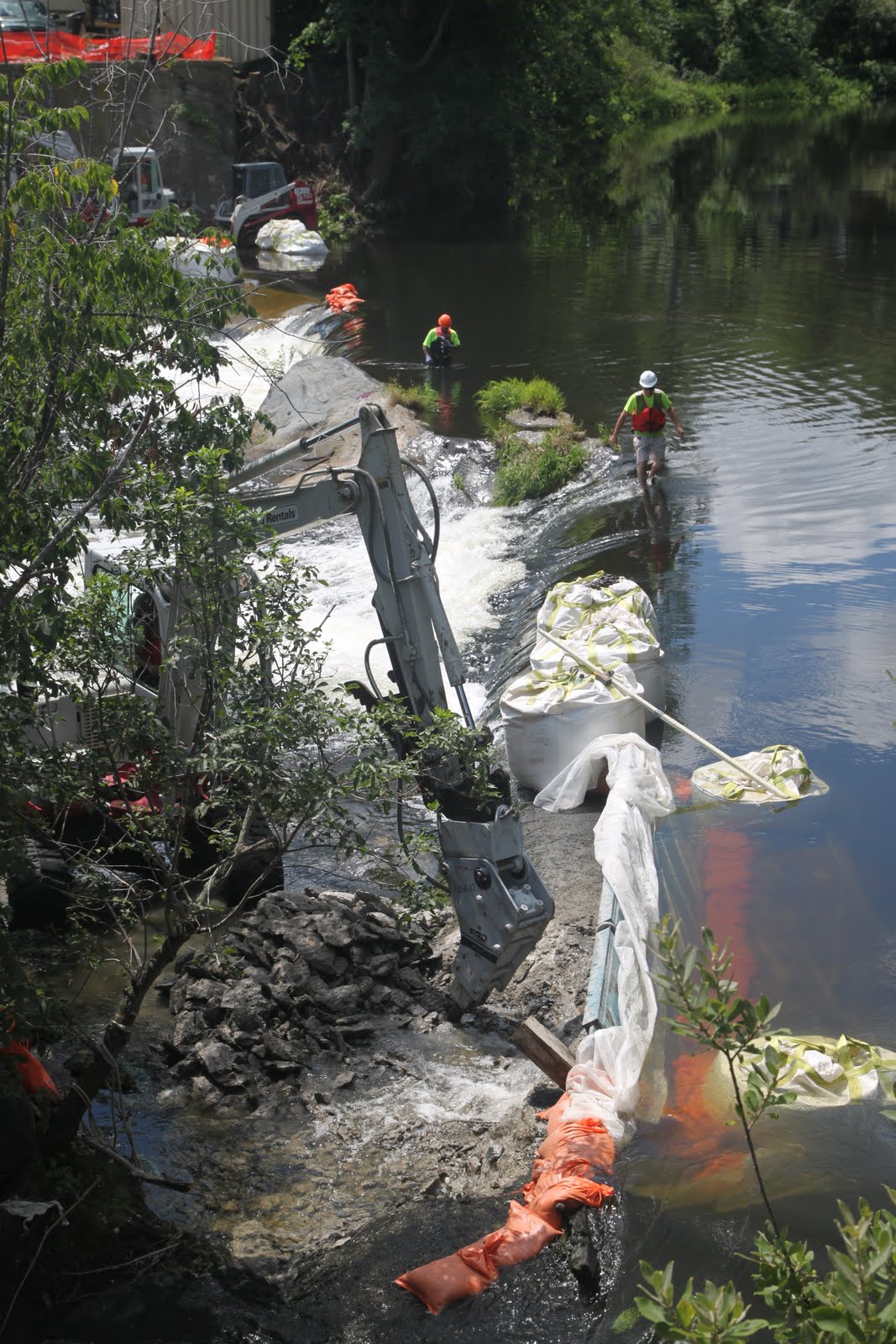
With the recent rains, the flow of the Pawtuxet River is much higher than anticipated, and construction crews are working to lower water levels as they begin to remove the dam. Two notches were carved out of the dam on Tuesday and Wednesday, and sandbags and steel plates are being used to control water levels. The river will not be drawn down more than 6 inches a day. In a few days, we should see more of the dam exposed. In these photos from today, you can see the hydraulic hammer working on the northern portion of the dam. A notch was cut in the southern part of the dam on Tuesday.

Subscribe to:
Posts (Atom)